
Criminal Court Records in Jackson County
A Jackson County criminal court record begins the moment a charging document reaches the clerk. The clerk of court opens a numbered case file, enters the parties, and logs every pleading, order, and hearing that follows. That file becomes the official account of the prosecution. It records the charges as filed, the defendant's plea, the motions argued, the verdict or negotiated outcome, and the sentence. Because the clerk maintains the docket and the minute book, the criminal court record, not an arrest log, is the document that proves how a case actually ended.
Two prosecuting offices drive most criminal filings here. The District Attorney for the 19th Judicial District, Angel Myers McIlrath, prosecutes felonies, while the County Prosecutor handles misdemeanors and felony preliminaries in the lower courts. Felony cases are tried in Circuit Court, which also hears criminal appeals from County Court. Misdemeanors and felony preliminary matters move through County Court, Justice Court, or one of the municipal courts in Pascagoula, Ocean Springs, Gautier, and Moss Point. Each court keeps its own criminal case files, so the record you need depends on the offense level and the court that handled it.
You can review the prosecuting authority that opens many felony files on the 19th Judicial District Attorney page.
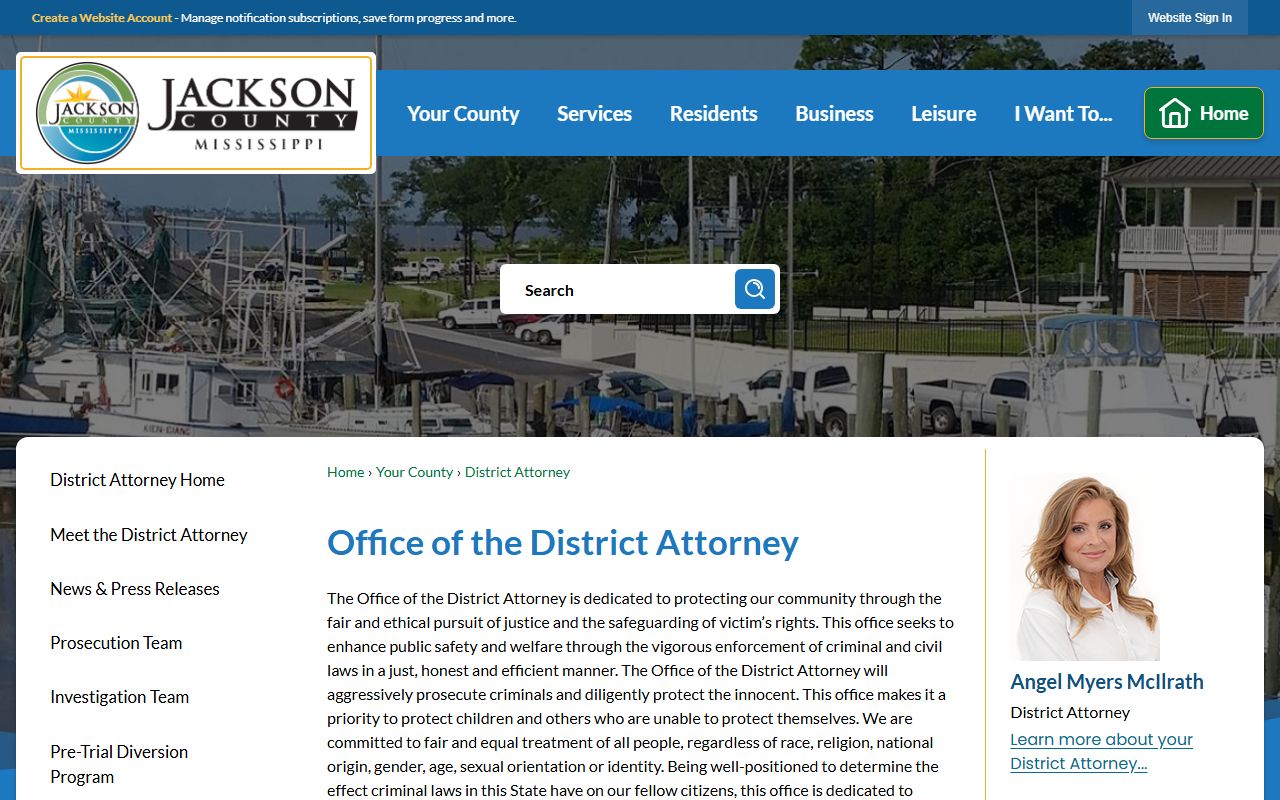
The District Attorney decides which felony charges to pursue, and those decisions shape what later appears in the criminal court record as filed charges, amendments, and final disposition.
How to Search Jackson County Criminal Court Records
Mississippi routes trial-court filings through Mississippi Electronic Courts, the statewide filing and case-management system. Public remote viewing of filed documents and case information generally requires a PAMEC login, and some attachments stay restricted to attorneys of record. For Circuit and County Court criminal files, the Circuit Clerk is the custodian, and certified copies come directly from that office rather than from any preview screen.
- Open the Mississippi Electronic Courts case search and register for a PAMEC viewing account if you do not have one.
- Search by defendant name or by the assigned criminal case number.
- Narrow the results by court, case type, and filing date to find the right file.
- Open the case to read the docket entries, charges, plea, and final disposition.
- Request a certified copy from the Circuit Clerk when you need an official version.
For misdemeanor or citation matters, contact the court that handled the case directly. Justice Court publishes separate phone lines for ticket, criminal, and civil questions, and each municipal court keeps its own files. The closer look at the charges themselves, including how a charge is amended or dropped, lives in the Jackson County court charge records.
The office that prosecutes misdemeanors and felony preliminaries is described on the Jackson County Prosecutor page.
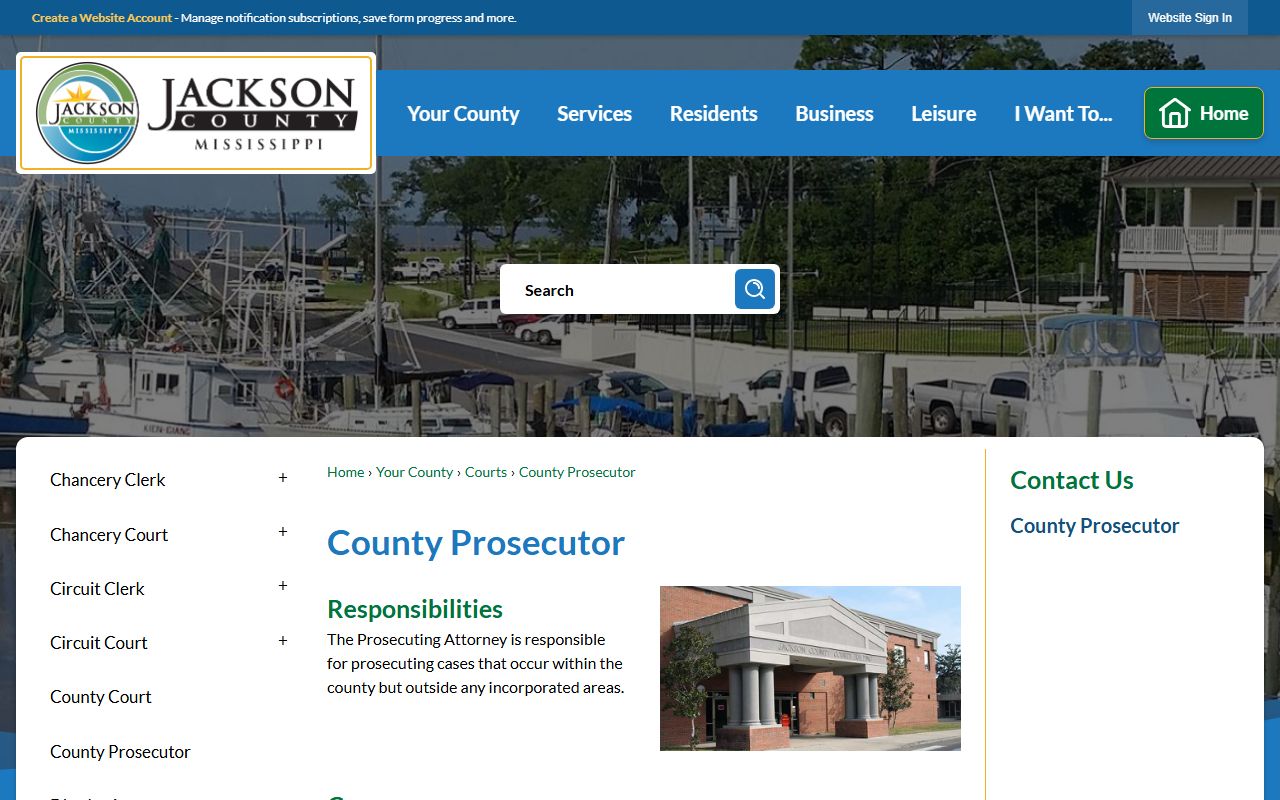
The County Prosecutor works in Justice and County Courts, so its cases populate the misdemeanor and preliminary-hearing entries you will read in many local criminal court records.
Stages of a Criminal Case
A criminal case moves through predictable steps, and each step leaves a mark in the file. The charging stage opens the record. Arraignment adds the first plea. Pretrial motions, continuances, and hearings fill the docket through the middle of the case. The plea or trial produces the outcome, and sentencing closes the matter with the penalty. Reading those entries in order shows exactly where a case stands and how it was resolved.
Case flow: Charges Filed › Arraignment › Pretrial / Motions › Plea or Trial › Disposition › Sentencing
| Stage | What Happens |
|---|---|
| Arraignment | The defendant appears, hears the charges read, and enters a plea of guilty, not guilty, or no contest. |
| Pretrial / Motions | Attorneys file and argue motions, exchange discovery, set bond conditions, and schedule the case for trial. |
| Plea or Trial | The case resolves by a negotiated plea or proceeds to a bench or jury trial that returns a verdict. |
| Sentencing | After a guilty plea or conviction, the judge imposes a sentence and records any probation, restitution, or costs. |
Indigent defendants in felony cases are represented from arraignment through trial. The county Public Defender, led by Amanda Galle, staffs that role from an office at 3108 Canty Street in Pascagoula. Appointed defense entries, motions, and continuances all appear in the docket alongside the prosecution's filings.
Details about appointed felony defense appear on the Jackson County Public Defender page.
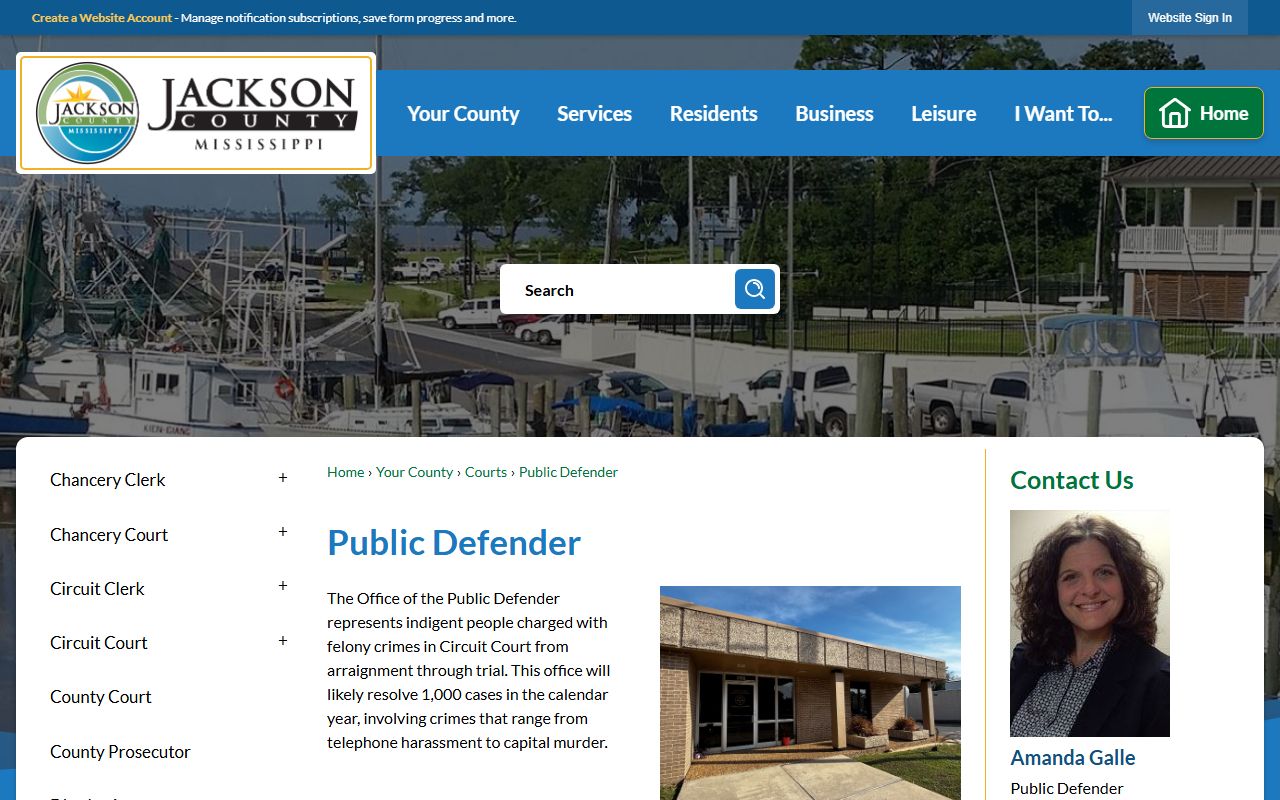
Because the Public Defender represents many felony defendants, its appearances and filings often form part of the same Jackson County criminal court record you are reviewing.
What a Jackson County Criminal Court Record Shows
The criminal case file is organized around a set of standard fields. Some come from the charging document, some from the docket, and some from the final judgment. Reading them together gives the full story of the prosecution. The table below walks through the core fields you will see when you open a Jackson County criminal court record and explains what each one tells you.
| Field | What It Shows |
|---|---|
| Case Number | The unique identifier the clerk assigns to the file, used to pull every document and docket entry. |
| Defendant | The person charged, listed with the parties and any co-defendants entered by the clerk. |
| Charges | The offenses named in the indictment, information, or complaint, with statute and severity level. |
| Plea | The defendant's formal response: guilty, not guilty, or no contest, recorded at arraignment. |
| Disposition | The final outcome of each charge, such as conviction, dismissal, acquittal, or nolle prosequi. |
| Sentence | The penalty ordered after a conviction or plea, including jail, prison, probation, fines, or restitution. |
The docket also lists motions, orders, bond, hearing settings, and appeal notices. The general docket kept by the Circuit Clerk records names and parties, pleas, indictments, papers filed, court orders, and references to the minute book where the judge's directives live. The full set of court files across every division is summarized in the broader Jackson County court records overview.
Charges vs. Convictions
Being charged is not the same as being convicted. A criminal court record can list charges that were later dropped, dismissed, or that ended in acquittal. A charge is only an accusation that the prosecutor believed there was probable cause to file. A conviction requires proof beyond a reasonable doubt, established by a guilty plea or a verdict. When you read a record, separate the filed charges from the final disposition before drawing any conclusion about the outcome.
| Charge | Conviction | |
|---|---|---|
| Stage | Accusation | Verdict or plea |
| Burden of Proof | Probable cause | Beyond reasonable doubt |
| Public Record | Yes | Yes |
Both charges and convictions appear in the public file, which is why the disposition field matters so much. A record that shows an arrest and a filed charge but no conviction may reflect a case that was dismissed or never prosecuted. Always read the disposition line before assuming a charge led to a finding of guilt.
Reading Dispositions and Sentences
Disposition codes summarize how each charge ended. Common entries include guilty, not guilty, dismissed, nolle prosequi, and deferred outcomes. A guilty disposition follows a plea or a verdict and leads to sentencing. A dismissal closes a charge without a conviction, and the docket may note whether it was dismissed with prejudice, meaning permanently, or without prejudice, meaning it could be refiled. Nolle prosequi means the prosecutor chose not to pursue the charge.
The sentence describes the penalty the judge imposed. It can include time in the county jail or in state custody, a suspended term, probation supervision, fines, court costs, and restitution to a victim. A record may show several charges with different dispositions, so each line must be read on its own. When a sentence routes a defendant into state prison, the case may also surface later in corrections records, while the court file remains the source for the order itself.
Sealed vs. Expunged Records
Some criminal records are removed from public view by court order. Sealing restricts access without destroying the file, so the record still exists but is hidden from ordinary searches. Expunction goes further and treats an eligible record as though it never existed for most purposes. In Mississippi, expunction is governed by statute, and eligibility turns on the offense type, the disposition, the completion of any sentence, and whether the petitioner has prior expunctions or excluded offenses.
| Sealed | Expunged | |
|---|---|---|
| Visibility | Hidden from public | Destroyed / treated as never existed |
| Law Enforcement | Limited access | Very limited |
| Eligibility | Court order in juvenile, sensitive, or protected matters | Dismissed charges and certain misdemeanors or felonies under Miss. Code Ann. § 99-19-71 |
A petition to expunge is usually filed in the court that holds the record, whether Justice, municipal, County, or Circuit Court. The petitioner gathers the case number, arresting agency, charge, disposition date, and proof that any sentence was completed. If the court grants the order, copies go to the clerk, the arresting agency, and the repositories that keep the record so public access closes.
Public Access to Criminal Court Records
Mississippi treats most criminal court files as public, subject to court rules and confidentiality orders. The Mississippi Public Records Act sets the baseline that public records are open for inspection unless a statute or rule makes them confidential. Court files add their own access layer through Mississippi Electronic Courts, which provides remote viewing but enforces privacy, redaction, and restricted-access rules. The existence of a case is usually public even when individual attachments are sealed or redacted.
Key Statutes:
Miss. Code Ann. § 25-61-1 - establishes that public records are open for inspection and copying unless a law makes them confidential.
Miss. Code Ann. § 99-19-71 - allows eligible dismissed cases and certain convictions to be expunged from public access by petition.
The electronic system also enforces privacy procedures spelled out in the Mississippi Electronic Courts Administrative Procedures. Filings must omit Social Security numbers, dates of birth, minor children's names, financial account numbers, and home addresses except as allowed, which is why a public docket can look complete while sensitive pages stay protected.
Federal Criminal Cases in the Southern District
Not every criminal case in the area is a county matter. Jackson County sits within the U.S. District Court for the Southern District of Mississippi, and federal charges are filed and tracked there, not with the Circuit Clerk. Federal drug, firearm, fraud, and other prosecutions use the federal docket system, and the closest courthouse for many Gulf Coast filings is in Gulfport. These cases are entirely separate from the local criminal court record.
Filed federal documents move through the court's electronic system, described on the Southern District CM/ECF page.
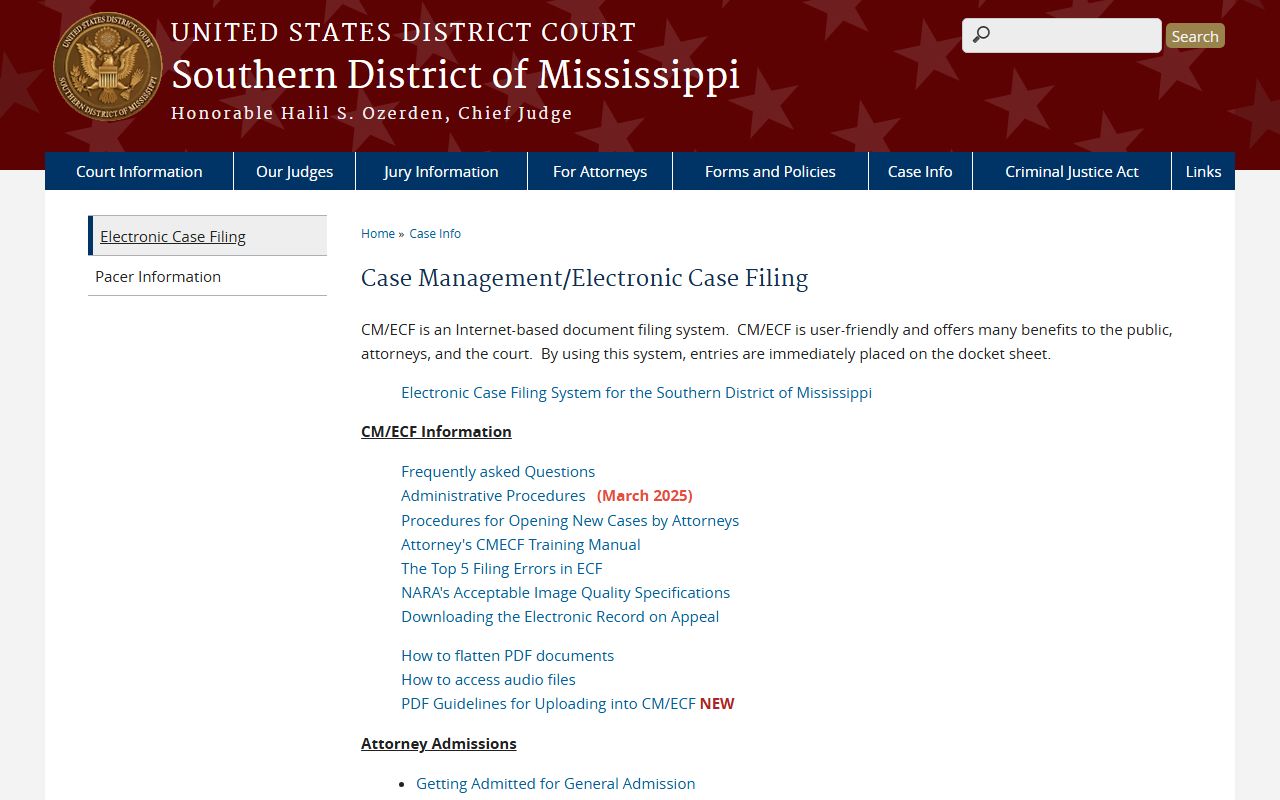
CM/ECF is the internet-based filing system that places each federal entry directly on the docket sheet, which is the federal counterpart to a county criminal docket.
Public access to those federal dockets runs through the service explained on the Southern District PACER information page.
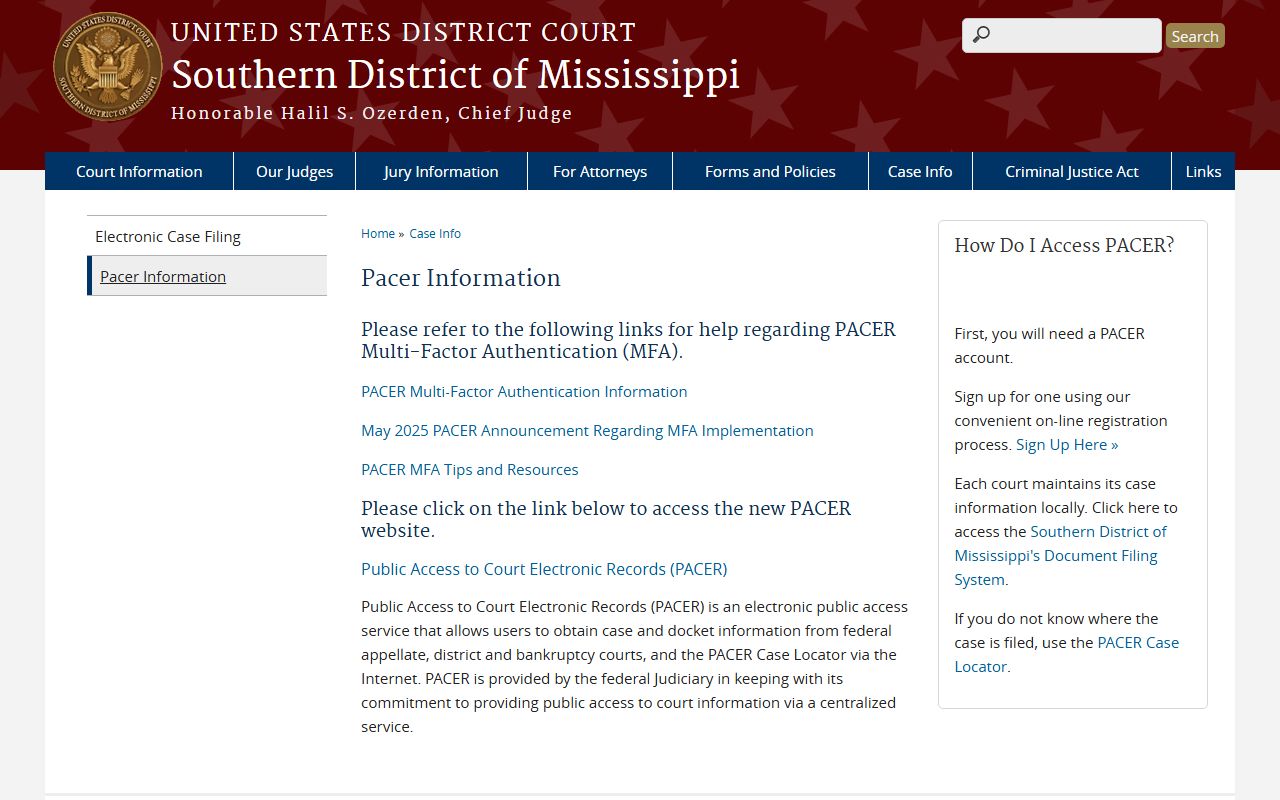
PACER provides electronic public access to federal appellate, district, and bankruptcy docket and case information for a per-page fee.
To reach the right federal court directly, use the PACER CM/ECF lookup for the Mississippi Southern District.
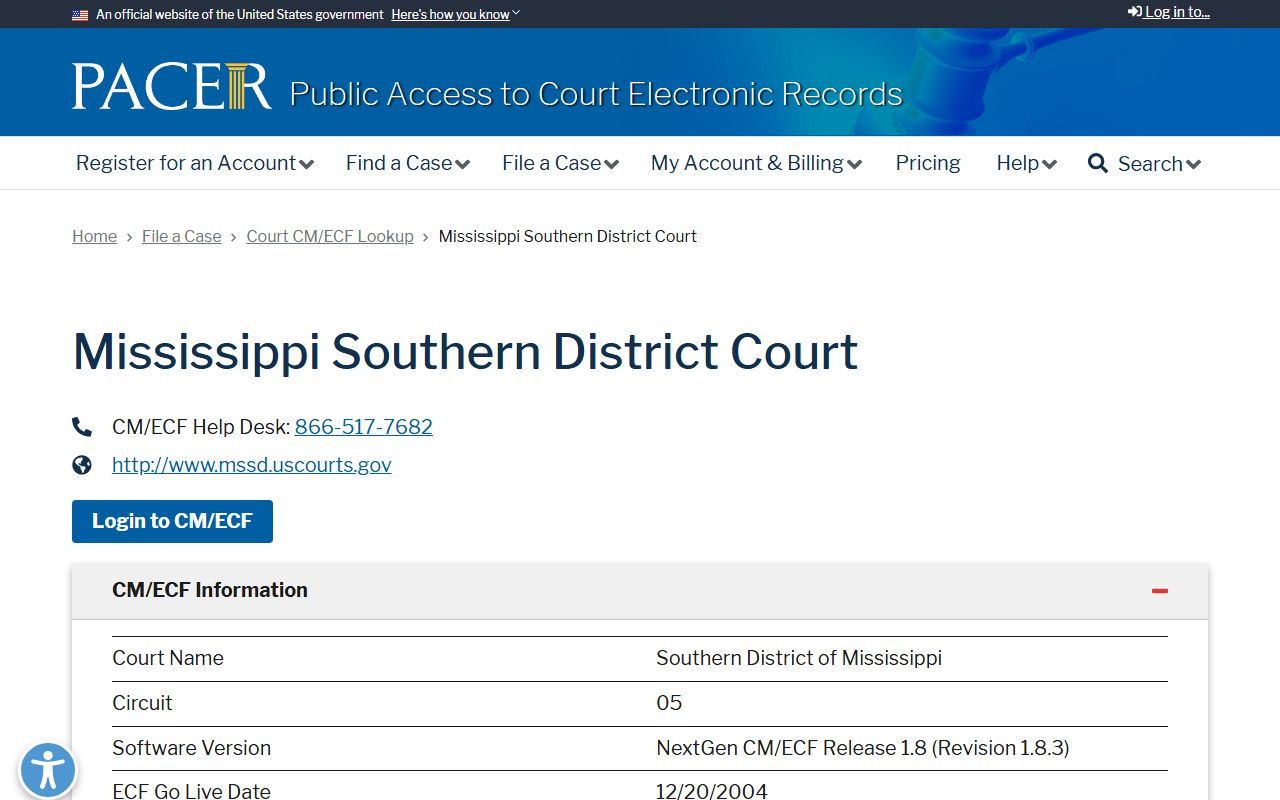
That lookup points to the correct CM/ECF portal for the district, so a federal criminal case here can be searched without confusing it with the county file.
Background Check Considerations
People search criminal court records for many reasons, and not every purpose is treated the same under the law. A casual lookup to confirm a case outcome is different from a formal background check used for employment, tenant screening, or credit. Formal screening must follow the Fair Credit Reporting Act and rely on a regulated consumer reporting agency. A direct review of court files through the clerk or the electronic system is informational and does not carry those protections.
Important: This website is not a consumer reporting agency under the FCRA, and its information may not be used for credit, employment, tenant, insurance, or other regulated screening decisions.
Restricted Criminal Court Records in Jackson County
Several categories of criminal court records are closed or limited. Youth Court matters, which are handled as a division of County Court, cover delinquent children, children in need of supervision, and abused or neglected children, and those files are confidential. Sealed and expunged cases may show nothing, only limited docket data, or restricted access once a court order takes effect. Active investigations and pending matters may also be withheld in part. Personal identifiers stay redacted under court privacy rules, and any active warrants tied to a case are tracked separately in the Jackson County warrant records.